SyPer Digital | Strategy, Storytelling, AI Insight

We removed one of the hardest parts of learning, but we may have replaced it with something harder.
How AI, search, and social media transformed how we research, shop, and learn, and why trust is now the most important skill.
CONSULTING INSIGHTSEDUCATIONAI
Sydney Pereira
4/16/20264 min read
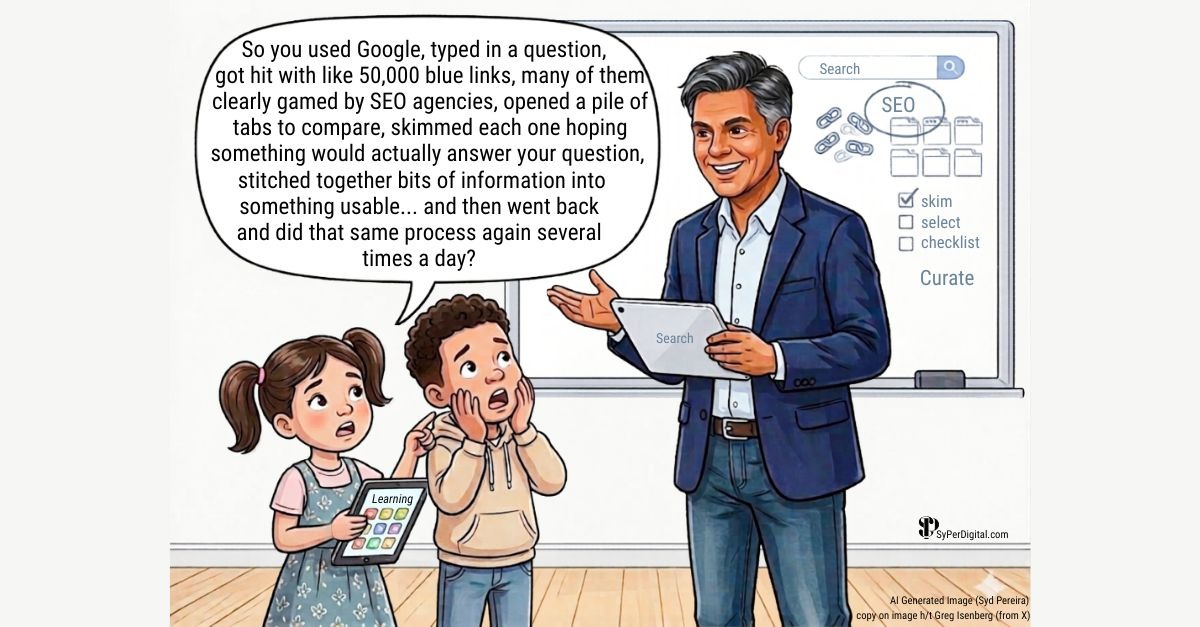
I can honestly see myself having this discussion with my niece (who is turning 5 at the end of this month) in a few years. She was born and is growing up in this AI era.
We have removed what was one of the hardest parts of learning, but we may have replaced it with something harder.
Finding information used to be the challenge.
Now? Knowing what to trust is.
For most of human history, access to knowledge wasn’t easy. You had to go to where it lived.
The idea of a library goes back thousands of years ... long before Google, long before the internet. One of the earliest examples was the Library of Alexandria, built around the 3rd century BCE. The goal was bold (and honestly very familiar).
Collect all the world's knowledge in 1 place.
Scrolls were gathered from across civilizations. Ships entering the port were searched for texts to copy. Knowledge was centralized, curated, and controlled.
Access wasn’t instant.
It wasn’t easy.
But it was intentional.
And for centuries, THAT was the model:
If you wanted answers, you had to go to where knowledge lived.
Then Everything Changed
The internet, and more specifically, search, shifted everything.
We didn’t need to go somewhere anymore.
We just needed to know what to type.
Google didn’t just make information accessible, it made it searchable.
And that changed behaviour.
Then We Stopped Searching
As platforms evolved, something subtle but important happened.
We stopped actively searching…
and started passively consuming.
YouTube showed us how
Social media fed us what we didn’t know we needed
TikTok compressed learning into seconds
In fact, nearly 40% of Gen Z now turn to platforms like TikTok or Instagram for search instead of traditional search engines.
Discovery became less about effort, and more about exposure.
And Now ... We Just Ask
With AI, we’ve entered a new phase.
We don’t search.
We don’t browse.
We don’t compare dozens of links.
We ask. And we get an answer.
Tools like ChatGPT reached 100 million users in just two months, making it one of the fastest-growing technologies ever adopted.
This shift isn’t coming. It’s already here.
This Shift Is Bigger Than Technology
The key shift to realize here, is that:
What’s really changed isn’t just the tools, it’s behaviour.
Its the ... How We Research
Then: Find sources
Now: Evaluate answers
The question used to be:
👉 Where can I find this?
Now it’s:
👉 Can I trust this?
Its the ... How We Shop
In 1998, when my (now) wife and I got married and bought our first home, we needed a fridge.
We knew nothing about fridges.
So we did what most people did at the time:
Went to a retailer I recognized from a radio ad that played in my on my drive to work every day
[SUPPLIER SELECTION]
When at the store, we discussed our needs with a salesperson at the store
[PROBLEM /NEED REQUEST]
He then gave us a list of 4 suggestions / recommendation to consider
[SOLUTION OPTIONS]
We made a decision
[PRODUCT SELECTION]
Simple. Linear. Human-driven.
Fast forward to 2010, our fridge broke. We decided to buy a new one. This time:
We Googled our need to get options
[PROBLEM /NEED REQUEST]
Compared models
[SOLUTION OPTIONS]
Read reviews / Asked friends on social before selecting the fridge we want to buy
[PRODUCT SELECTION]
Only then did we chose WHERE to buy (based on price and other factors)
[SUPPLIER SELCTION]
Same need. Completely different process flow.
Just a side note - today, over 90% of consumers read online reviews before making a purchase, and most decisions are shaped by multiple touchpoints, not a single interaction.
And If this happened today?
I’d probably just ask AI:
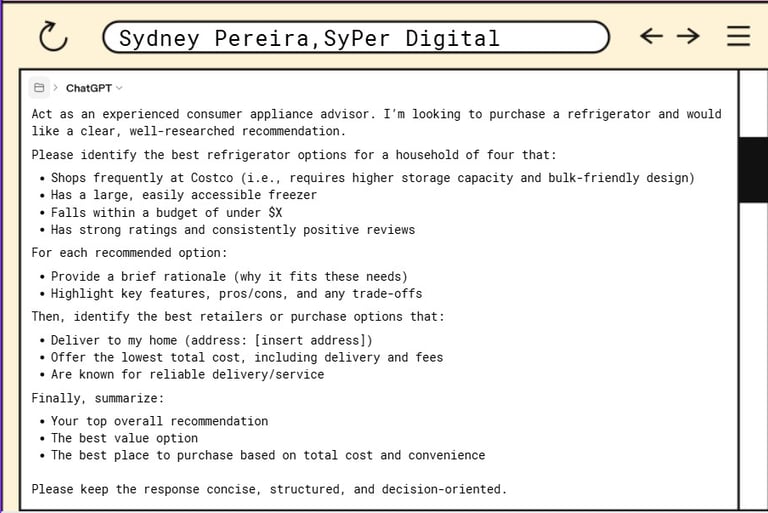
👉 “What’s the best fridge for my family to buy. We shop at Costco so a large assessible freezer space is important, will cost me under $X, and has the best ratings/reviews. Also let me know the best options for where I can purchase it from that will deliver to my home (address) with the least shipping costs”
And I’d get a summarized answer in seconds.
Side note/Disclosure: I kept the AI prompt above short to emphasize the change in process (ease, speed, quickness, and the just ask! As I have experience developing effective prompts, here's what my prompt would probably actually look like to optimize my results
How Businesses Get Found
This shift has massive implications for marketing.
We’ve gone from:
Being present
To being searchable (Google ERA)
To being discoverable (TikTok ERA)
And now?
👉 Being the answer (Ai ERA)
As discovery shifts from search results to AI-generated responses, brands are no longer just competing for clicks…they’re competing to be selected, summarized, and trusted.
The Real Shift
The real shift here is that we’ve moved from:
📍 Going to knowledge
TO
🔍 Searching for knowledge
TO
📲 Being fed knowledge
TO
💬 Asking for knowledge
And this shift is showing up everywhere:
In how students research
In how consumers buy
In how brands get discovered
The Tension (and Opportunity)
Here’s the part that I believe now matters most.
Access to information has never been easier. But trusting it, and understanding it? That still takes work.
Because while we’ve removed the friction of finding information, we’ve increased the importance of knowing its trustable. And interpreting it.
Final Thought
We didn’t just remove one of the hardest parts of learning. We replaced it with a new one.
And we’re still figuring out what that means, for education, for marketing, and for how we move forward.
Syd Pereira is a digital marketing strategist and educator exploring how trust, context, and technology shape communication. He writes about social media, AI, and learning.
This post is part of a growing collection of insights and resources, available on my [Resources page].

SyPer Digital
© 2026 SyPer Digital. All Rights Reserved.